St. Louis, Missouri 63101
Henry J Jost a.k.a "Duke"– born in 1870 - died 6/9/54
Opened shop in 1892 shortly after arriving in
the country from Germany
The source of the picture of Jost fishing, is from the July 18 1937 issue of the
Milwaukee Journal. The caption is missing, but here's a
transcription:
"What the
well-dressed fishermen [sic] wears, including, and one might say especially,
the hat and shoes, is shown by H. J. (Duke) Jost, St. Louis pipe manufacturer,
just before going out on Planting Ground lake, one of the Three Lakes
waters."
Bio: (supplied by jguss - Thank you!)
The business was founded
by Henry Jacob Jost, nicknamed “Duke”. Jost was born in Hesse, Germany on Feb
7, 1870, and died in St Louis, MO on June 9, 1954. He was married c. 1893 to
Julia Meinhardt (b. Hesse, Germany May 24, 1871, died in St Louis, MO on August
11, 1932), and emigrated to America about the same time, becoming naturalized
in 1895. Note that there are a variety of dates given for Henry's marriage and
immigration; I prefer those from the 1900 census as closest in time to the
actual events.
Son Louis (from the Henry J Jost & Son)
Henry and Julia had one
child, a son named Louis William Jost (b. St Louis, MO on May 23, 1901, died in
St. Louis, MO on February 15, 1940). Louis married in 1926 to Adah Wittkopf (b.
St Louis, MO August 31, 1903, died in St. Louis, MO on June 12, 1991). Adah was
one of three daughters born to Gustav F. Wittkopf (b. in MO Nov 12, 1865, died May
19, 1961), and Lena Stahl (b. in MO September 26, 1872, died in St Louis, MO on
February 13, 1943); early census records make it clear that Adah lived down the
block from Louis, and I assume that’s how they met.
Henry is listed in the
St Louis city directories by 1899 as a turner (and the 1900 census likewise
describes him as a wood turner), but within a few years he is listed as a
seller of umbrellas. The actual date he began his business is unclear;
different sources give different dates, but almost all of them are from things
published many years after the fact. One newspaper article from 1939 says Henry
opened shop in 1892; Adah’s obituary, on the other hand, states that Henry
opened his business in 1905, and that canes as well as umbrellas were sold.
Certainly canes, umbrellas, and pipes all involved the turning of wood, and
there is separate evidence that Henry learned these skills in Germany before
coming to America.
Note: Jost's sold walking sticks / canes through the 70s at least from accounts of shop patrons.
The precise date the
shop open is probably impossible to ascertain, and in part depends on what we
mean by a shop. In all likelihood Henry worked for someone else before starting
his own business; moreover the business clearly evolved over the years,
changing both location and merchandise. At any rate, by 1909 Henry is listed in
the St Louis city directory under umbrellas (sorry for the pun) at 1424 S
Broadway; it is only in 1914 that his listing is expanded to cover umbrellas
and pipes, and in that year a second address is included at 110 N 6th. In 1916
the listing is still for both umbrellas and pipes, but the Broadway address is
now gone, with only the 110 N 6th address remaining. By 1921 the umbrellas are
dropped for good, and Jost’s listing only mentions pipes. Jost stayed at 110 N
6th through 1933, but by 1936 (there's a couple year gap in the directories in
the source I consulted) the business appears at 208 N 6th; moreover it is now
listed as “H J Jost & Son”, presumably not just reflecting Henry’s advanced
age (63), but his son Louis’s maturity at age 35. The business stays at the 208
N 6th address for most if not all of its remaining history.
Note: addresses on my catalogs state 201 N. 6th Street - some discrepancy
Bill Collins:
From pipepedia: Bill Collins was a local pipemaker
in St. Louis, Missouri. His artisan's name was Jost. Jost was a pipe and
tobacco store in St. Louis, Missouri. Jost employed a pipe repairer and maker
named Bill Collins.
No other information exists for Bill Collins' association with the Jost shop.
Mrs. Henry Jost 1954-1970s (although it looks like Raspberry ran the shop from 1960-)
(see Adah Jost entry below - for further clarification)
Presumably took over the shop after her late-husband's death. Tagged as a woman pipe smoker she seems to have worked well with Harvey Raspberry for the remainder of her career at Jost. She passed on management of the operation to Harvey Raspberry in or around 1960.
"She and
Harvey Raspberry give lessons in the shop. There are two comfortable chairs in
the corner of the shop where a smoker can sit and have his smoking progress
checked under the watchful eyes of Mrs. Jost or pipemaker Raspberry."
Adah Jost / Wittkopf / Fantilli (b. St Louis, MO August 31, 1903, died in St. Louis, MO on June 12, 1991)
It is my belief SHE is the Mrs. Henry Jost mentioned above based on dates and not Henry's wife, Julia. Julia passed away in 1932 and Henry never remarried. Adah was Louis' wife and she is confirmed to have worked at the Jost shop with Henry.
Note that the
directories list Adah as manager by 1955 (Henry died the prior year, and Louis
was long dead). Fortunately we’re not entirely dependent on an incomplete run
of city directories; in fact Adah’s obituary states that upon her husband
Louis’s death in 1940, she became a co-owner of the pipe shop along with her
father-in-law "Duke" (i.e. Henry). After his death in 1954 she became
sole owner, and continued to operate the business until 1988, just three years
before her death.
Sometime after 1940,
widow Adah remarried to a musician named August L. Fantilli (b. in Queens, NY
on February 15, 1906, died in St Louis, MO on May 15, 1979). Whether or not
this affected her involvement in the shop is unclear, but I infer not since she
continues to figure prominently in newspaper articles and oral recollections
for many, many years to come.
Harvey Raspberry (pipe carver / Shop Owner) ~1960-1983 (b. 10/6/1914 - d.09/15/2007)
In the 1930 census
Harvey, age 15, was still living in Arkansas; he had moved to Missouri by the
early thirties, and in the 1940 census was listed as a clerk in a pipe store.
According to his obituary Harvey retired in 1984, some four years before Adah
closed the business. Assuming the pipe shop he was working at in 1940 was the
one belonging to Henry Jost, Harvey was with the same business over 44 years.
Harvey managed the shop from roughly 1960 through its closing in 1983. Examples of his pipes were very unique from its carvings to odd / natural characteristics in the briar (ex. Plateau tops to knobby shanks, etc). These pipes stand out in a crowd and are excellent pieces if you can find them. There are no discerning marks and the pipes are quite a bit different than standard or Comoy house pipes offered throughout Jost Pipe Shop's history.
Bio from a Raspberry / Rufus Family Reunion program:
Harvey Newell
Raspberry was born in Harmony Grove Community which is near Camden, AR. However, his family moved to Pine Bluff where
he received his formal education at Catholic Elementary and the public school
of Pine Bluff, AR. He lives in St.
Louis, MO with his wife, Vivian DeShield.
Harvey is a pipe smoking builder and managed Jost Pipe Shop more than 25
years. He retired in 1984 as a Real
Estate Broker. The Harvey Rasperries’
hobbies are fishing, playing bridge and pinochle. He is a member of the A.M.E. Church and is a
member of the trustee board. Harvey was
one of the initiators of the First Raspberry and Rufus Family Reunion.
Note: Based on discussions I've had with Jon (provider of mountains of useful info!) the term "manager" might be loosely used based on the reports from Raspberry family members. It's perfectly conceivable Harvey ran the shop from time-to-time. The title "Manager" will stay based on his experience and interaction with the customers. There is no mention of Ownership in any way.
H. J. Jost & Son, Inc. is
a Missouri Domestic General Business filed on April 20, 1983. The company's
filing status is listed as Forfeited and its File Number is 00251383.
The Registered Agent on file for this company is Harvey Raspberry and is
located at 201 North 6th Street St Louis, MO 63101.
The Shop:
From Pipepedia: The shops last location was at
6th and Olive under the spiral ramp for the Famous and Barr parking lot. The
shops wall were lined with glass display cases for pipes. There was a regulator
clock on the wall that ticked with a rhythm that reminded you that pipes were
to be smoked patiently and slowly. One of their best selling tobaccos was Old
Virgina. A wonderful unique lacey ribbon cut virginia with latakia.
A local's recollection of the shop ~1959:
"I
was raised in St. Louis, born in 1939. I moved away in 1963. It was about 1959
that I was introduced to the Jost's Pipe Shop. In conversations, Mrs. Jost
referred to her deceased husband with a reverence when discussing
"pipe" opinions. The shop was not large, by Iwan Ries standards, but
it had a charm and old world character. Harvey Raspberry was always so cordial
and assisted with sales as well as making pipe repairs. Harvey was also an avid
bridge player and had attained his Master status. The team of Mrs. Jost and
Harvey was low key but successful with encouraging their clients' enjoyment of
pipe smoking. They had a knack for remembering their clients' preferences for
pipe styles and grades, and tobacco preferrences. As I recall, they only sold
their own blends of tobacco which were offered as Jost's Virginia, Jost's
Deluxe and Jost's Old English. I don't recall the years nor the exact
addresses, but I believe their shop that I first visited was closed and moved
to a new location sometime in the 1960s. The original shop was in a building
which was to be demolished and the new shop was nearby on the street perimeter
(street level) of the Famous-Barr Department store (a division of Macy's). I
still have and enjoy smoking perhaps twenty Jost's pipes." - pipe forum post
Another local's recollection ~1982
"I bought my
first 2 pipes from Harvey in 1982, so the shop was still in business at that
time. My first was a Canadian and 2nd was an Oom Paul. I still smoke them
regularly. Harvey was always a most charming gentleman. As for the shop, as I
remember, it wasn't huge but it was very comfortable,and welcoming. Very
pleasant shop indeed." - pipe forum post
Another local's recollection (date unknown)
"I was
reading an old news article and was reminded of a pipe shop from years ago in
downtown St. Louis. It was Jost's pipe shop.. It was run by Mrs. Jost in the
early seventies when I was in there, and she was a pipe smoker. They made their
own pipes and walking sticks on site. Their carver was a very old man at that
time named Harvey Raspberry. They had signed pictures on the wall of all the
celebrities they had made pipes for including Clark Gable and Bing Crosby.
I was young at the time, and could not afford their pipes, and was looking at
tobacco. I made the mistake of saying I couldn't smoke a particular tobacco,
because it bites. She promptly told me I could smoke anything I wanted if I did
it properly. She said most men, regardless of length of time smoking, did not
know how to properly smoke a pipe. She allowed as how most men had never owned
a truly good pipe so they didn't know the difference, and were most likely
smoking "candified" tobacco.
Another customer was there at the time picking up a new pipe. The carver took
it apart, explaining the various parts, the importance of proper drilling, and
the significance of using only Algerian plateau briar. They offered smoking
lessons to buyers of their pipes to teach how to load and smoke a pipe
properly. Those kinds of shops are long gone." - pipe forum post
MKlaw pipes recollection from his wonderful pipe site:
"Jost’s Pipe Shop was a fixture in downtown St. Louis for
many years. I was only there once, I think in 1965, but it was a
memorable experience. The man behind the counter was Harvey Raspberry, an
African-American pipe maker and salesman extraordinaire. Though I had
almost no money in those days, I walked out with two Jost’s pipes, both of
which turned out to be favorites. One was lost years ago and the other I
still smoke from time to time. Mr. Raspberry told me that a pipe should
be broken in “like a hound dog - hard.”
The Tobaccos:
From a catalog / pamphlet 1950s/1960s:
Duke's Blend (Likely named after Henry)
Cavendish and Virginia-Smooth and Mellow
1/2 lb - $6.00 Pound - $10.25
Lou's Blend (Likely named after Henry's Son Louis)
Black Cavendish - Cool Smoking
1/2 lb $6.00 Pound - $10.25
201 Blend
Liqueur Cased - Smooth, Tasty & Aromatic
1/2 lb. - $6.00 Pound $10.25
Eccentric
Satisfying Flavor added to a Masterly Blend of Virginia, Perique, Burley and Latakia
1/2 lb. $6.00 Pound $10.25
VIRGINIA BLEND
4 Virginias, fine cut, Burley & Latakia Expertly Blended
1/2 lb $5.50 Pound $9.25
recollection / inquiry via Pipe Forum:
"Through
the early 70's St. Louis had a wonderful pipe shop called Josts. They sold a
mix called Virginia. Aside from its wonderful aroma, it was distinctive in its
texture. All the virginia was ribbon cut in single leaf thickness--not bulk cut
like some cavendish. The virginia was very golden yellow in color. The mix also
had a fairly good amount of latakia. On the side of the 3x3x5 tin was the
marking "Manufactured Tobacco TP-16 W. VA"
SUPREME
Bright Virginia, Latakia & Perique - Mild and Mellow
1/2 lb - $5.50 Pound $9.25
OLDE ENGLISH
Blend of Virginia, Havana, Perique & Latakia - Extremely Smooth - dry smoke
1/2 lb - $5.50 Pound $9.25
DELUXE
Mellow flue cut Blend of Virginia, Latakia, Perique and Turkish Tobaccos
1/2 lb - $5.50 Pound $9.25
Not sure of the significance but some of these tobacco names were in UPPER CASE and I feel they might have been blended either off-site OR they were original blends of Jost.
From an Earlier Catalog:
Jost's THAMES:
A rich aromatic smoke this is unequaled in smooth, cool burning qualities. Teh flavor and aroma are unique. A masterly blend of Burley, Perique, Virginia and Flavor. Half Pound $5.00 Full Pound $8.25
Jost's ECCENTRIC
A satisfying flavor added to a luxury mixture of Burley, Latkia, Virginia, Perique with a touch of Havana to create a smoke that tastes exceptionally smooth and rich. Half Pound $5.00 Full Pound $8.25
Jost's DE LUXE
A rich and fragrant subtle mixture of selected burleys, mellow flue-cured tobaccos, sun bright pikckings, Perique, Latakia and Turkish. Expertly blended with a top dressing and casing. Half Pound $4.50 Full Pound $7.75
Jost's OLD ENGLISH
An extremely smooth, aromatic dry smoke combining flue-cured burleys, coarse cut Havana, coarse cut Perique, Latakia and sun bright pickings. Epertly blended with a special top dressing and casing. Half Pound $4.50 Full Pound $7.75
Jost's SUPREME
A most mild adn mellow misture of flue-cured tobaccos, bright Virginia coarse cut, Latakia and Perique. Expertly blended with a special top dressing and casing. Half Pound $4.50 Full Pound $7.75
Jost's STRAIGHT VIRGINIA
A most mild yet satisfying combination of Virginia Tobaccos. A blend of burleys, of flue-cured burleys and Latakia. Expertly blended with a special top dressing and casing. Half Pound $4.50 Full Pound $7.75.
The Pipes:
Jost's Pipes
are closely tied to Comoy. Many of Jost's pipes have the standard Comoy shape
number and the "Made in England " in a circle. If the Jost's pipe
doesn't have the "Made in England " it is probably made by Harwey
Raspberry.
If the pipe has a shape number that is preceded by a "J" that is a Comoy product without question. Typically these will have the words "Made in London England" on the reverse side of the shank from where the Jost stamp is made. There are always exceptions to the rule but 95% of the time, this is accurate.
Many different levels of pipes were offered by Jost's Pipe Shop. From a 1950s catalog I have the following available:
Jost Old English DeLuxe: $85.00
These were typically of the highest quality briar Comoy had to offer. See pictures below of a pipe I restored - came out looking like a champ. Grain is stunning and the briar is flawless. These are the grade you should look out for as they are great smokers.
Jost Old English Supreme: (no pricing available)
The majority of he Old English version pipes you see are marked Supreme. These are stained in a darker color and are presumably from the same Algerian aged Briar as the DeLuxe brothers. These are also of the highest quality available.
Jost Virgin Briar Supreme: $35.00
Don't see too many marked as Virgin Briar Supreme but you will often find "Supreme" Jost pipes on the second hand market (see above). Excellent quality briar and displays the lighter toned finish of the DeLuxe above. Grain is not as flashy or desirable as the De Luxe model.
Jost Thames Briars: $25.00
I've seen these offered as blasted / rusticated pipes and look quite nice. Most of the smooth finish Thames pipes are riddled with fills. Good smokers but not much to look at (smooth).
Jost Sandblast Briars: $25.00
These are a great value. The shop made sand-blasted pipes are usually quite large and snapped up very quickly by collectors. The Comoy versions (with Jshape #s) are of excellent quality and typically rather small compared to the shop-made variety.
Dukes Briars: $15.00
These come up very rarely. The two I've seen in recent years are rather small in size. Smooth finish with light / honey stain color. Not sure what the story is behind these.
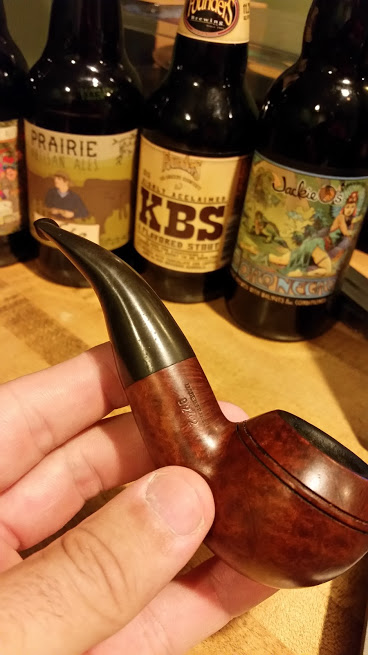
Pictures of a Jost Old English de Luxe I restored and regrettably sold (this is from pipestud's relisting of the pipe):
Pictures of my Jost Author which is currently on e-bay (ending Easter Sunday):
This pipe is likely a Comoy Product. No markings other than the Jost stamping so it's probably fairly old (40s?) Great smoker and lovely shape. Obviously this pipe has been loved as it shows some scratches on the bowl.
Pictures and details of pipes to follows!
As always, if you have further information on the Jost Shop please feel free to contact me. Pictures of the shop or recollections of the shop are always welcome!